Showing posts with label nikon. Show all posts
Showing posts with label nikon. Show all posts
Saturday, December 14, 2013
Nikon DSLR battery project, some changes
Nikon battery project continues, after a long time "no activity" period. There is going to be changes in the converter and battery configuration. Because the availability status of MHB75-12S12 -converter from ELFA (expected availability after 03/2014) and and battery capacity (to be increased), the new system will have two 4S LiPo batteries. Second battery in the system will be from Orion, 4S LiPo 14.8V 6400mAh. This doubling the portable battery capacity, what is needed mainly for tracking mount and dew heaters. Converter will be a model of 24V to 12V, Meanwell type MHB75-24S12.

Monday, November 5, 2012
Nikon DSLR battery project, converter selection
Some background investigation is done now. Few samples from couple of DC/DC converter manufacturers, seems a good solution. One that I first noticed, was 75Watt series from Meanwell. Type MHB75-12S12 provides conversion from 4S LiPo cell voltage to constant output voltage. Most important spec are:
Half-brick size (2.28" 2.4" 0.5")
2:1 wide input range
Protections: Short circuit / Over current / Over voltage / Over temperature
High efficiency up to 89%
Built-in remote ON/OFF control
Built-in remote sense
Trimming output 10%
Five-sided shield metal case
For more detailed information, check MHB75-12S12 specs here. This type of converter, is in sale at Elfa Distrelec.
Half-brick size (2.28" 2.4" 0.5")
2:1 wide input range
Protections: Short circuit / Over current / Over voltage / Over temperature
High efficiency up to 89%
Built-in remote ON/OFF control
Built-in remote sense
Trimming output 10%
Five-sided shield metal case
For more detailed information, check MHB75-12S12 specs here. This type of converter, is in sale at Elfa Distrelec.
Friday, November 2, 2012
Nikon DSLR battery project, converter specs
This battery project, requires some additional electronics. Main purpose is to keep output voltage stable as the input voltage changes (depending on the amount of 4S LiPo cell discharge level).
There is many options and manufactures to look at... First I will check what local stores (like YE, Partco and Elfa) are selling. I will make later decisions, what voltage converter to use. Because of efficiency requirements, converter module based on the linear technology, is not an option here...
requirements:
There is many options and manufactures to look at... First I will check what local stores (like YE, Partco and Elfa) are selling. I will make later decisions, what voltage converter to use. Because of efficiency requirements, converter module based on the linear technology, is not an option here...
requirements:
-typical input voltage 14.8…16.8V DC
-output voltage 12...13.5V DC
-output current 6A continuous
-efficiency bigger than 80%
-input low voltage cut-off @ 14V
=> 4*3.5V for 4S LiPo
-output short circuit protected
-preferred as PCB model
-small size recommended
-small heatsink usage - ok
Sunday, October 28, 2012
Nikon DSLR battery project, 4S LiPo testing
Project test continues with 4S LiPo battery (Orion 14.8V 6400mAh). Only D200 camera was powered. I used four diodes as voltage dropper (1N3879 switching diode). This solution is only temporary, more sophisticated one would be low loss switch mode voltage converter....
camera setup
***************************************
Nikon D200
300/4.5 lens (at max aperture)
raw images used
ISO800
menu: high ISO NR, off
menu: long exposure NR, off
"M" mode used
bulb exposure selected
camera at room temp, approx +23C
exposure setup
************************
MC36 trigger used
delay 10sec
exposure 60sec
interval 62sec
no limit in image count
Results (27th Oct)
*******************************
Diodes heat up a bit during testing, without heat sink used. Test was stopped, when voltage per cell approx at 3.5V level (some cells were 3.2/3.3V, two last at 3.6V, slightly uneven discharging). Totally 472 images were taken. It corresponds to three times more images, than in 3S LiPo 2100mAh test setup.
camera setup
***************************************
Nikon D200
300/4.5 lens (at max aperture)
raw images used
ISO800
menu: high ISO NR, off
menu: long exposure NR, off
"M" mode used
bulb exposure selected
camera at room temp, approx +23C
exposure setup
************************
MC36 trigger used
delay 10sec
exposure 60sec
interval 62sec
no limit in image count
Results (27th Oct)
*******************************
Diodes heat up a bit during testing, without heat sink used. Test was stopped, when voltage per cell approx at 3.5V level (some cells were 3.2/3.3V, two last at 3.6V, slightly uneven discharging). Totally 472 images were taken. It corresponds to three times more images, than in 3S LiPo 2100mAh test setup.
Tuesday, October 23, 2012
Nikon DSLR battery project, 3S LiPo testing
I put the Orion 3S 11.1V LiPo cell (2100mAh version) to test. Nikon D200 is directly fed with this battery, no EN-EL3E used at battery slot. Small fuse of 2.5A is used in series to protect camera... I made the test without MB-D200 battery pack.
Power cord I took from my Nikon EH-6 AC supply. A sacrifice to science was made, and wire cut with scissors :-) Starting voltage at 3S LiPo battery, was 12.4V. I will at least run test down to 11.1V, maybe even a bit below that, if D200 still operates correctly.

Settings in the camera, were following:
****************************************
Nikon D200
300/4.5 lens (at max aperture)
raw images used
ISO800
menu: high ISO NR, off
menu: long exposure NR, off
"M" mode used
bulb exposure selected
camera at room temp, approx +23C
exposure setup
************************
MC36 trigger used
delay 10sec
exposure 60sec (1min)
interval 62 (1min 2 sec)
no limit in image count
Results (23rd October)
*******************************
Sequnce was run, until voltage under load was 3.5V per cell (overall 10.5V). Totally 145 images were taken. There is capacity increase noticed, when compared to 48 images with single EN-EL3E and 91 images with dual EN-EL3E (with MB-D200 battery grip).
Results (24th October)
*******************************
Orion 3S Lipo battery was charged again. Now it took bit longer than last time, approximately 75min to full charge. Test settings were same as above, totally 149 images taken.
Power cord I took from my Nikon EH-6 AC supply. A sacrifice to science was made, and wire cut with scissors :-) Starting voltage at 3S LiPo battery, was 12.4V. I will at least run test down to 11.1V, maybe even a bit below that, if D200 still operates correctly.

Settings in the camera, were following:
****************************************
Nikon D200
300/4.5 lens (at max aperture)
raw images used
ISO800
menu: high ISO NR, off
menu: long exposure NR, off
"M" mode used
bulb exposure selected
camera at room temp, approx +23C
exposure setup
************************
MC36 trigger used
delay 10sec
exposure 60sec (1min)
interval 62 (1min 2 sec)
no limit in image count
Results (23rd October)
*******************************
Sequnce was run, until voltage under load was 3.5V per cell (overall 10.5V). Totally 145 images were taken. There is capacity increase noticed, when compared to 48 images with single EN-EL3E and 91 images with dual EN-EL3E (with MB-D200 battery grip).
Results (24th October)
*******************************
Orion 3S Lipo battery was charged again. Now it took bit longer than last time, approximately 75min to full charge. Test settings were same as above, totally 149 images taken.
Sunday, October 21, 2012
Nikon DSLR battery project, LiPo charging
Both batteries are now charged, all went OK as expected. No heating was noticed in the battery, when touched by hand. During 4S LiPo charging, charger itself heated (not still too hot to touch).
Following figures below, show the main data during charging. 3S LiPo was charged with full current (2.1A). Even it was defined higher current - 5 Amps - for the Orion 4S 6400mAh LiPo, approximate value was 3.3Amp.
Following figures below, show the main data during charging. 3S LiPo was charged with full current (2.1A). Even it was defined higher current - 5 Amps - for the Orion 4S 6400mAh LiPo, approximate value was 3.3Amp.
 |
| Charging data for 3S 2100mAh LiPo |
 |
| Charging data for 4S 6400mAh LiPo |
Nikon DSLR battery project, used equipment
Here is a brief view, to selected equipment - what I use my LiPo battery project:
Microcontrolled charger (Robitronic LD15z)
Orion LiPo 3S 11.1V 2100mAh battery
Orion LiPo 4S 14.8V 6400mAh battery
Drawback in the first battery, is the output voltage range. In full charge (3*4.2V=12.6V) it can feed Nikon D200 without any voltage converter. When battery is discharged, voltage drops below the specified level. It remains to be seen, whether it affects to camera operation.... This battery equals to capacity, usually found in pro-DSLR's, like D3/D4.
The second one, provides approcimately three times capacity than first one (3S 2100mAh version). Output voltage in the 4S version, is too high to be connected directly to D200. Fully charged battery provides approximately 16.8V. Nikon own power supply EH-6 provides specified 13.5V output voltage. Connecting battery directly, might blow up my camera, and I do not want it to happen. So in first phase of test, I propably will make diode connection is series. That will drop voltage approximately 3V (5*0.6V). Then output voltage would vary somewhere in range of 11.8...13.8V.
Microcontrolled charger (Robitronic LD15z)
Orion LiPo 3S 11.1V 2100mAh battery
Orion LiPo 4S 14.8V 6400mAh battery
Drawback in the first battery, is the output voltage range. In full charge (3*4.2V=12.6V) it can feed Nikon D200 without any voltage converter. When battery is discharged, voltage drops below the specified level. It remains to be seen, whether it affects to camera operation.... This battery equals to capacity, usually found in pro-DSLR's, like D3/D4.
The second one, provides approcimately three times capacity than first one (3S 2100mAh version). Output voltage in the 4S version, is too high to be connected directly to D200. Fully charged battery provides approximately 16.8V. Nikon own power supply EH-6 provides specified 13.5V output voltage. Connecting battery directly, might blow up my camera, and I do not want it to happen. So in first phase of test, I propably will make diode connection is series. That will drop voltage approximately 3V (5*0.6V). Then output voltage would vary somewhere in range of 11.8...13.8V.
 |
| Microcontroller charger |
 |
| Orion 3S LiPo battery |
 |
| Orion 4S LiPo battery |
Thursday, October 18, 2012
Nikon DSLR battery project, EN-EL3E measurements
Short time ago, I made a test to check - what is approximate capacity of a single or dual EN-EL3E battery capacity (in taken images, before imaging totally stops). Basic test setup was following:
-Nikon D200
-300/4.5 lens (at max aperture)
-raw images used
-ISO800
-menu: high ISO NR, off
-menu: long exposure NR, off
-"M" mode used
-bulb exposure selected
-camera at room temp, approx +23C
*****
-MC36 trigger used
-delay 10sec
-exposure 60sec (1min)
-interval 62 (1min 2 sec)
-no limit in image count
It is not fully same, as camera used in low temperatures, like -20C. I would estimate, that in the cold environment - maybe 50...70% of this coud be achieved.
results were:
D200 Used with single EN-EL3E (without MB-D200) -> best result 49 images.
D200 Used with two EN-EL3E (with MB-D200) -> best result 91 images.
-Nikon D200
-300/4.5 lens (at max aperture)
-raw images used
-ISO800
-menu: high ISO NR, off
-menu: long exposure NR, off
-"M" mode used
-bulb exposure selected
-camera at room temp, approx +23C
*****
-MC36 trigger used
-delay 10sec
-exposure 60sec (1min)
-interval 62 (1min 2 sec)
-no limit in image count
It is not fully same, as camera used in low temperatures, like -20C. I would estimate, that in the cold environment - maybe 50...70% of this coud be achieved.
results were:
D200 Used with single EN-EL3E (without MB-D200) -> best result 49 images.
D200 Used with two EN-EL3E (with MB-D200) -> best result 91 images.
Nikon DSLR battery project, introduction
Time to take a new project. Many times I have noticed on the outside, that Nikon D200 pulls out effectively the full charge out of batteries. The supplied EN-EL3E is not provided with a big capacity. In cold temperatures like -20...-30C, image count could be as less as 20...30.
Insteadt of using older lead-acid technology, I selected Litium technology. This provides higher capacity in same volume & weight. The downside of this, is higher price tag.
Purpose of this project, is to provide capacity at least 3 times, compared to normal setup with Nikon D200 drived with single or two EN-EL3E LiIon batteries. I selected LiPo (litium polymer) battery type, because those are easily available in stores selling stuff for RC hobbyists. Microcontrolled chargers, provide accurate charging of LiPo battery. More will follow, when project continues. Stay tuned :-)
Insteadt of using older lead-acid technology, I selected Litium technology. This provides higher capacity in same volume & weight. The downside of this, is higher price tag.
Purpose of this project, is to provide capacity at least 3 times, compared to normal setup with Nikon D200 drived with single or two EN-EL3E LiIon batteries. I selected LiPo (litium polymer) battery type, because those are easily available in stores selling stuff for RC hobbyists. Microcontrolled chargers, provide accurate charging of LiPo battery. More will follow, when project continues. Stay tuned :-)
Nikon EH-6 secrets, part 6
Small update to blog post, since new Nikon consumer & pro DSLR's have been released and already on the market:
-D800/D800E: not compatible to EH-6 (uses EH-5B; with adapter EP-5B).
-D600: not compatible to EH-6 (uses EH-5B; with adapter EP-5B).
-D4: compatible to EH-6B, but requires EP-6 adapter (dummy battery with EH-6 input connector)
-D800/D800E: not compatible to EH-6 (uses EH-5B; with adapter EP-5B).
-D600: not compatible to EH-6 (uses EH-5B; with adapter EP-5B).
-D4: compatible to EH-6B, but requires EP-6 adapter (dummy battery with EH-6 input connector)
Tuesday, March 27, 2012
Nikon D200 problems, part 3
Unfortunately, again problems with my Nikon D200 body. This time it is visible in the the raw -images already.
There was noticed strange banding all over the image area. Narrow stripes are located closely to each other. In a portrait image, stripes are visible as horizontally. The phenomenon gets worse, when the camera is exposed to low temperatures, like -20C and below that. I am not sure, is this a typical behavior for D200.
Two images attached, lower one is scaled from original to 800pix in height. Banding is only slightly visible. Upper image is direct crop in the middle of image, without scaling.


There was noticed strange banding all over the image area. Narrow stripes are located closely to each other. In a portrait image, stripes are visible as horizontally. The phenomenon gets worse, when the camera is exposed to low temperatures, like -20C and below that. I am not sure, is this a typical behavior for D200.
Two images attached, lower one is scaled from original to 800pix in height. Banding is only slightly visible. Upper image is direct crop in the middle of image, without scaling.


Sunday, November 27, 2011
Imaging laptop, accessories arrived
On last week, I got packet delivery from UPS, ordered accessories arrived:
 So there is now a rigid Pelican 1450 -case for imaging laptop (Lenovo EDGE11). All the stuff is needed to put in (laptop, powersupply, display heater, heater controller, usb / ethernet cables). Case also needs suitable connector panel, so there is many things to solve...
The company (Cameranu.nl), where I ordered the equipment, did not make any effort to protect the Nikon CCP2 software package. In the big box, there was no softening material inside at all !!! The disk case has suffered, from the rough handling (see broken lower right corner of plastic cover). CD -disk seems to be in good condition.

 So there is now a rigid Pelican 1450 -case for imaging laptop (Lenovo EDGE11). All the stuff is needed to put in (laptop, powersupply, display heater, heater controller, usb / ethernet cables). Case also needs suitable connector panel, so there is many things to solve...
The company (Cameranu.nl), where I ordered the equipment, did not make any effort to protect the Nikon CCP2 software package. In the big box, there was no softening material inside at all !!! The disk case has suffered, from the rough handling (see broken lower right corner of plastic cover). CD -disk seems to be in good condition.
Tuesday, November 1, 2011
Astroimaging, EL foils arrived
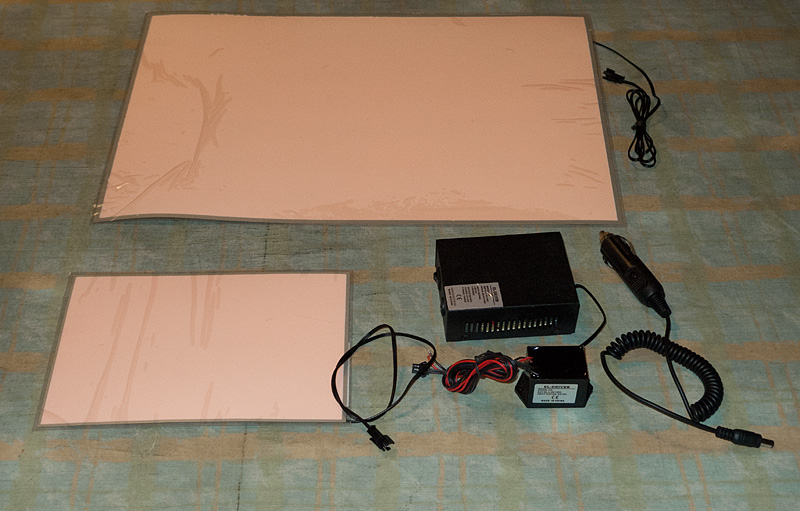
Last week I got a a delivery from Glowhut. Feels like christmas now, yippee :-) Both 12V powered A5 and A3 foils will need some enclosure or similar frame, that would support the structure. More on that, later on...
Monday, October 17, 2011
Astroimaging, accessories...
Preparing my photo system this time. I do not yet have a decent solution to take a flatfield calibration images. Many astrophotographers today, use a convenient EL-foil solution. The foil is thin, and provides even illumination. So It was time get ones for myself also:
A5 EL-foil (white)
12V inverter
I will use these in combination with Nikon D200 & 300/4.5 tele lens.
A5 EL-foil (white)
12V inverter
I will use these in combination with Nikon D200 & 300/4.5 tele lens.
Saturday, October 8, 2011
Imaging laptop, controlling Nikon DSLR...
Plan is to dive into the world of deepsky photography, mainly galaxies and star clusters. These will be first targets, since my current camera (Nikon D200) is not yet modified for astrophotography, when H-alpha band is considered. I have planned to use 300mm MF Nikkor tele lens.
For controlling Nikon from the imaging laptop, I have purchased following stuff from Shoestring Astronomy:
DSUSB contoller
Nikon 10pin interface cable
My mount (HEQ5) has certain faults in bearing, tightened propably too much. And go-to kit I already have - that is to be installed. I will use USB2EQ5-cable to connect laptop to the mount.
For controlling Nikon from the imaging laptop, I have purchased following stuff from Shoestring Astronomy:
DSUSB contoller
Nikon 10pin interface cable
My mount (HEQ5) has certain faults in bearing, tightened propably too much. And go-to kit I already have - that is to be installed. I will use USB2EQ5-cable to connect laptop to the mount.
Thursday, October 6, 2011
Imaging laptop, accessories...
Only one "mandatory" software missing, Nikon Camera Control Pro2. Carrying case for the laptop, there was one suitable model from Pelican. Today I placed an order of following gear:
Nikon Camera Control Pro2 upgrade
Pelican 1450 case
Both of them were out of stock currently, delivery shall be estimated in two weeks...
Nikon Camera Control Pro2 upgrade
Pelican 1450 case
Both of them were out of stock currently, delivery shall be estimated in two weeks...
Saturday, October 17, 2009
Nikon EH-6 secrets, part 5
Here is the view to a bottom sticker at Nikon EH-6 power supply: Described are - input voltage range, ouput voltage and current (13.5V, 5A) and also pins of power connector.
 Described are - input voltage range, ouput voltage and current (13.5V, 5A) and also pins of power connector.
Wednesday, October 14, 2009
Nikon EH-6 secrets, part4
Recently Nikon annouced D3s digital SLR, with fast frame rate for pro users. Interesting camera, you can always dream of it :-) D3s is compatible with EH-6 external power supply.
Friday, July 31, 2009
Nikon EH-6 secrets, part3
Status update: Nikon announced two new DSLR bodies, updated D300s and entry level D3000. Both of them are not compatible with EH-6 supply, instead EH-5 is required (4 pin connection to camera).
Friday, February 13, 2009
Nikon D200 problems, part 2
Today I picked up my D200 camera from the service. It was a positive surprise to me... It has been repaired for free of charge.
Mirror mechanics had been replaced and adjusted. Also cleaning and camera final testing was included. Firmware was updated to version 2.00. When I looked the info leaflet, more was about to come... Also there was following items replaced, and again free of charge (!)
-grip rubber unit
-I/F side rubber unit
-bottom cover rubber unit
-front body unit
-rear rubber unit
During repairing, I told also to find out total shutter count. It was 3926 images, since I bought camera at 03/2006. Not very much... I should start using my camera more often.
Thanks goes to Nikon and JAS Tekniikka for a good service !
Mirror mechanics had been replaced and adjusted. Also cleaning and camera final testing was included. Firmware was updated to version 2.00. When I looked the info leaflet, more was about to come... Also there was following items replaced, and again free of charge (!)
-grip rubber unit
-I/F side rubber unit
-bottom cover rubber unit
-front body unit
-rear rubber unit
During repairing, I told also to find out total shutter count. It was 3926 images, since I bought camera at 03/2006. Not very much... I should start using my camera more often.
Thanks goes to Nikon and JAS Tekniikka for a good service !
Subscribe to:
Posts (Atom)